What it is
Ad Studio takes an ad worth learning from and makes you your own version of it.
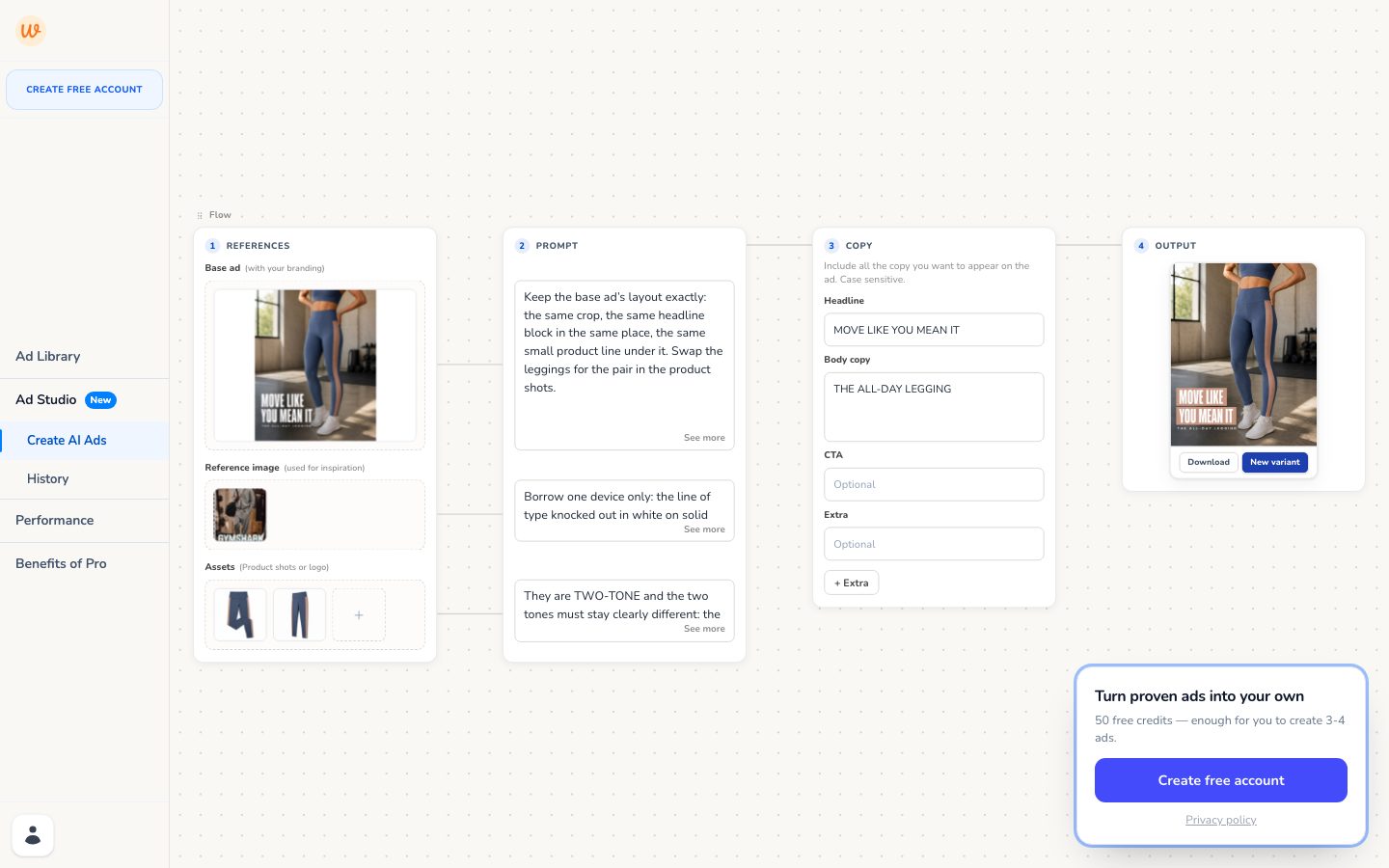
It starts from what you already have: an ad of your own, an ad whose layout you want to borrow, and photos of your product.
It makes still image ads in the sizes Meta runs, not video.
What I did
Ad Studio is part of the Wilow app, so its code was written by Wilow's developers. My part was the product side: scoping the feature, the mockups and the handoff to the developers.
It went live on 2026-08-25.
How it works
You start by browsing a brand in Wilow's free Meta Ads Library and finding a layout worth learning from.
Then you add your own base ad and product photos. Each slot accepts a direct upload and takes its own instruction, so it works before you have connected an ad account.
The copy goes in four labelled boxes: headline, body copy, call to action and an extra line.
The image is made by OpenAI's GPT Image 2.5 Sunburst at high quality. A run is paid for in credits, and the credit packs are sold through Polar.
A vertical 9:16 ad can be previewed as it would look in Instagram Reels, and Download saves the ad on its own.
Decisions that shaped it
The borrowed ad is sent as a guide to layout and art direction only. It lends structure: where the type sits, how the blocks stack, how the product is framed. It never lends its brand, logo, product, packaging or words, and that rule is enforced on Wilow's servers rather than asked for in a prompt.
Testing showed that without your own copy the model lifts wording from the borrowed ad. So the words on the ad are yours to supply, in their own boxes.
The credit meter was built before the generator shipped, so the most expensive action in the product was never given away. A failed generation refunds its credits.
Testing the image model
A sibling model, GPT Image 2.5 Flare, was tested and rejected because it rewrote the brand it had been told to leave alone.
Wilow also ran its own test of GPT Image 2.5's five quality settings, to decide what Ad Studio pays for. Every setting drew the test watch correctly, even the cheapest. The higher settings add fine surface texture that only shows when the product fills a big image.
Inside a full ad, Low and Max looked the same, and a bigger reference photo changed the result more than the setting did. At OpenAI's rates in September 2026, Max cost about six times as much as Low.
 OpenAI
 Meta
 Polar